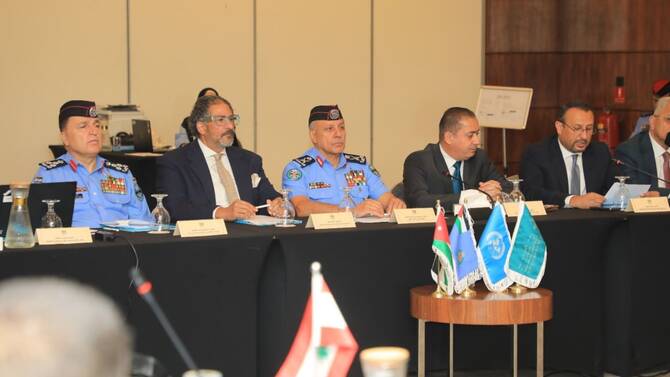
Security and government officials from Jordan, the Syrian Arab Republic, Iraq, Egypt, Saudi Arabia, and Lebanon convened in Amman for a regional meeting on Monday. The three-day gathering addressed the synthetic drug trade affecting Middle Eastern nations. Officials from the various countries participated in the discussions, aiming to bolster regional cooperation against the illicit narcotics trade. The meeting, which began on Monday and spanned three days, brought together key stakeholders to confront a widespread issue impacting stability and public health across the region.
Regional Drug Threat Focus
The meeting in Amman aims to enhance security and judicial responses to cross-border drug threats, according to Maj. Gen. Obaidallah Maaytah, director-general of the Public Security Directorate (PSD). Maaytah stated that participants would also exchange best practices in monitoring the production, trafficking, and distribution of synthetic drugs. This full approach is designed to create a more unified and effective front against the sophisticated networks involved in drug smuggling. Captagon remains a dominant synthetic drug impacting the Middle East, posing significant challenges to law enforcement agencies. Smuggling networks have attempted to exploit Jordan’s geographic location, using it as a transit point for illicit drugs bound for Gulf countries. The geographical position of Jordan, bordering several key nations, makes it a critical corridor for drug traffickers, necessitating strong counter-narcotics strategies.
Syria's Shifting Role
Syria, under the leadership of Bashar Assad, had been identified by various reports as a central hub for the production and distribution of captagon. This synthetic drug has significantly impacted the Middle East, with vast quantities originating from Syrian territories and then being trafficked across borders. The regime of Bashar Assad fell in December 2024, marking a significant change in the political landscape of the Syrian Arab Republic. This development raises questions about its potential impact on the regional drug trade and the strategies for combating it. The ongoing discussions in Amman are expected to address how the altered situation in Syria might influence future efforts to counter drug trafficking routes and production networks. The political vacuum and potential shifts in control within Syrian territories could either exacerbate or alleviate the drug production problem, a key concern for neighboring states.
Collaborative Efforts and History
The meeting in Amman was organized by Jordan’s Public Security Directorate, in cooperation with the UN Office on Drugs and Crime and the Naif Arab University for Security Sciences. This gathering builds on previous regional discussions regarding the illicit drug trade. The first meeting involving the five countries present in Amman—Jordan, Iraq, Egypt, Saudi Arabia, and Lebanon—along with the UN to address the issue of synthetic drugs took place last year. That initial discussion was hosted in Riyadh, Saudi Arabia, setting a precedent for the current collaborative efforts to combat the growing regional threat posed by synthetic narcotics. These ongoing dialogues show a concerted regional commitment to tackling the complex challenges presented by drug trafficking, sharing intelligence, and coordinating enforcement actions across national borders.
Intercepted Captagon Tablets
Authorities across the Arab region have intercepted at least 177 million Captagon tablets since late 2024. These interceptions highlight the scale of the illicit synthetic drug trade impacting the Middle East. The sheer volume of these seizures points to a highly organized and widespread trafficking operation that demands a coordinated international response. The ongoing efforts aim to disrupt these significant trafficking operations, which not only fuel addiction but also contribute to instability and organized crime within the region. The continued vigilance and enhanced cooperation among regional security forces are key to stemming the flow of these dangerous substances.